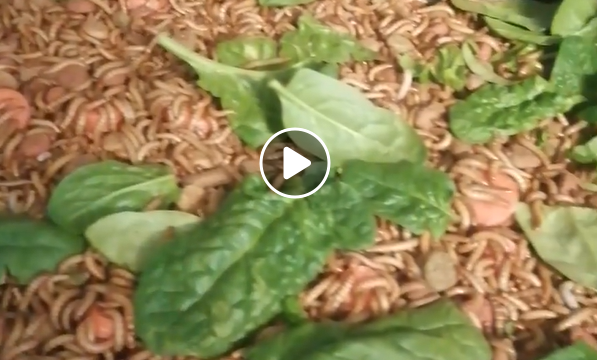
It is now the middle of January, as the breeders continue to enforce hierarchies within the aviaries in the colony, I am preparing the insects (in this case, mealworms) for the cooked and frozen food protocol.
The innovative feeding protocol that I have been “using” in animal husbandry for several years consists of preparing the insects ( in some cases also fed) for the process of boiling and refrigeration. This allows us to significantly lower the bacterial loads present especially in terrestrial insects ( example:earthworms, crickets, snails etc.).
The boiling time varies depending on the insect and the cuticle that covers it. In this case I am feeding flour moths carrots, spinach leaves, dried nettle leaves, dog kibble, this allows me to “purge” the insect and raise its vitamin and protein value. Moths fed exclusively on bran have nutritional imbalances, in fact they have too high a fat content and are deficient in protein and calcium.
We must also pay attention to the stages in which the larva, the adult ( a kind of black beetle) , the eggs, the moth, the larva etc.,’ the development of the various generations depends mainly on the temperature, ideal around 25 degrees. The time at which to boil is before the cuticle change, at this time the moths stop eating and this is the right time, which in the boiling stage allows us to get the insect nice ” full” and not emptied if done in different time.
Here you will find the 13 correct steps I adopt for this insect.
- The first thing to do is to sift them, so as to remove any residue (bran, droppings, etc.).
- Then I put them in a tightly knit colander, and rinse continuously.
- This done, the larvae are ready for boiling.
- I put water to boil in a pot in a large dose relative to the larvae to be boiled. When the water boils I immerse the larvae in the pot for a couple of minutes.
- At the end of the gentle boiling, I drain the larvae by pouring the contents of the pot into a strainer and then immediately into a container containing cold water.
- This operation involves heat shocking the larvae so as to neutralize any remaining bacteria in the larvae.
- I leave the larvae in cold water for a few minutes and then drain them with the colander used previously, and cover them with a cloth.
- I let it sit for about 24 hours, when the larvae have dried, they are ready for refrigeration.
- It is advisable to use small containers according to the farmer’s daily requirements so that the amount of product needed can be easily thawed.
- I then place the plastic bags, in the freezer.
- To thaw the larvae, I recommend taking them out of the freezer and soaking them in a colander with warm water to recreate the heat shock effect and further reset bacterial loads still present. It is advisable to do the boiling operation, not indoors but outside, perhaps on a small stove, both for hygiene and because of the unpleasant odor that such treatment can give off.
